Multi-step
Reasoning agent with tool selection, retrieval, integrity checks, and synthesis.
Elasticsearch Agent Builder project
SciVerify turns literature-backed claim checking into a transparent, multi-step agent workflow. It retrieves evidence, grades study quality, flags integrity risks, and returns a traceable verdict.
Reasoning agent with tool selection, retrieval, integrity checks, and synthesis.
Custom ES|QL tools, semantic search, and scheduled workflows rather than prompt-only output.
Focused on scientific evidence verification where provenance and study quality matter.
Why this exists
A reader sees a headline claiming that a diet intervention reverses ageing or reduces inflammation. Verifying that statement usually means searching papers, screening abstracts, weighing methodology, checking for retractions, and spotting funding conflicts.
SciVerify compresses that work into a repeatable agent workflow without hiding the reasoning steps. The result is not just an answer. It is an auditable chain of evidence.
Literature search and first-pass synthesis drop from hours to seconds for scoped claims.
Evidence comes from Elasticsearch retrieval and ES|QL outputs, not fabricated references.
BiasDetector checks for cherry-picking, funding signals, and quality gaps before the final verdict.
Demo
Shows decomposition, semantic retrieval, ES|QL filtering, methodology assessment, integrity checks, and verdict generation.
Download MP4
Highlights quality-focused tools such as
find_high_quality_evidence and methodology distribution analysis.
Workflow
Break the claim into subject, intervention, outcome, and population.
Run semantic search and ES|QL filters in parallel to pull relevant literature.
Score relevance, study type, citation strength, and support versus contradiction.
Flag retractions, weak sample sizes, funding signals, and outlier patterns.
Produce a verdict, confidence level, evidence map, and reasoning trace.
Architecture
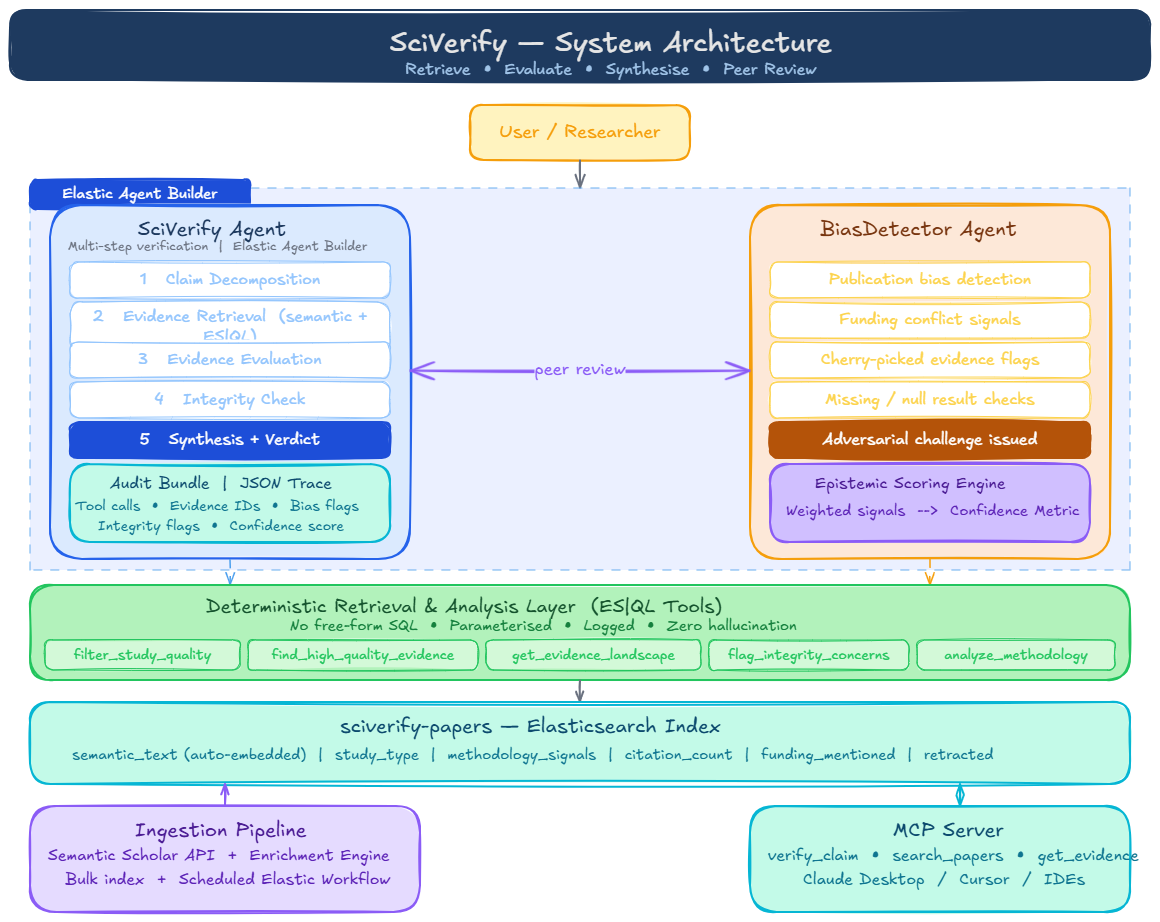
The system uses Elasticsearch for indexed literature, semantic retrieval, and ES|QL analytics. Agent Builder orchestrates a primary verification agent and a peer-review agent that challenges weak conclusions.
Build notes
This project fits the Elastic Agent Builder brief closely: a context-driven, tool-using, multi-step agent with measurable operational value in a narrow domain.
Agent Builder agents, custom ES|QL tools, semantic retrieval, multi-agent review, and workflow-based ingestion freshness.
Balancing retrieval precision with broad literature coverage, making reasoning visible, and preventing overconfident synthesis from sparse or biased evidence.
Explore the project